
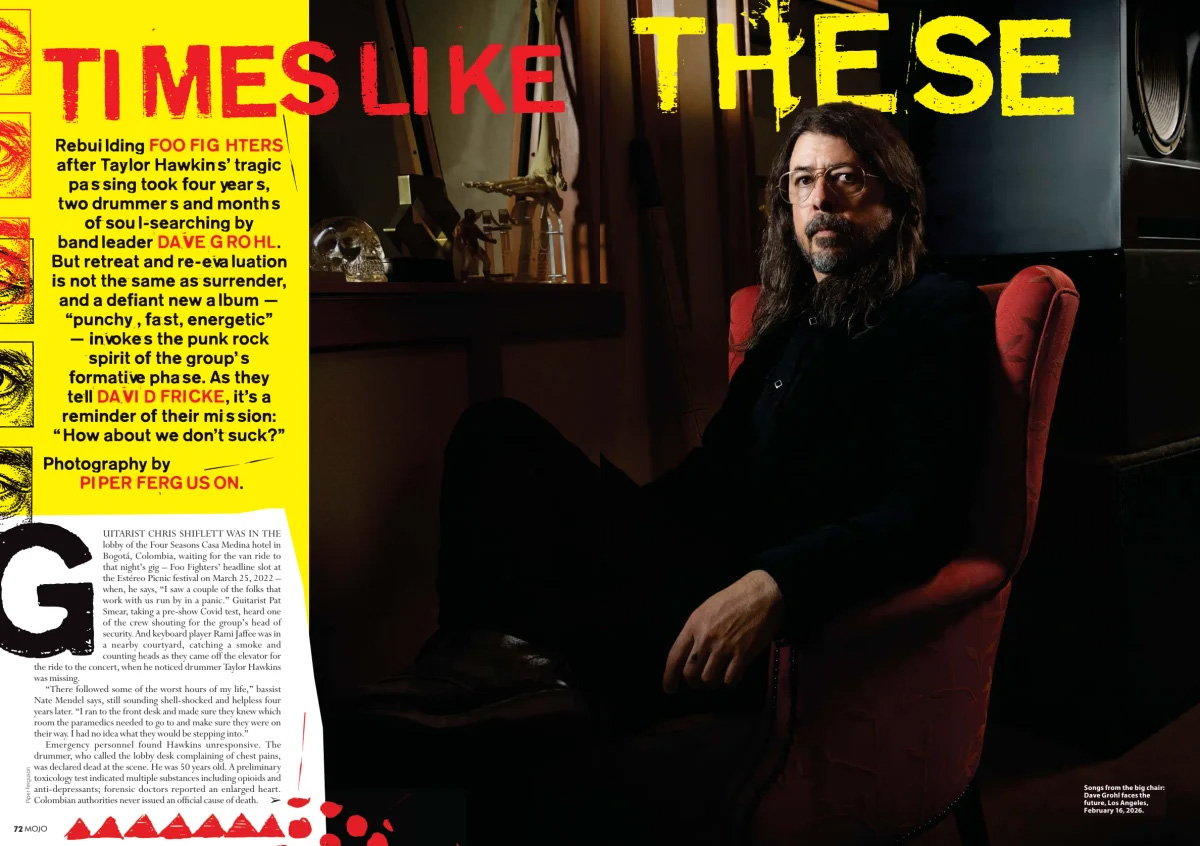
 Guitarist Chris Shiflett was in the lobby of the Four Seasons Casa Medina hotel in Bogota, Colombia, waiting for the van ride to that night's gig - Foo Fighters' headline slot at the Estereo Picnic festival on March 25, 2022 - when, he says, "I saw a couple of the folks that work with us run by in a panic." Guitarist Pat Smear, taking a pre-show Covid test, heard one of the crew shouting for the group's head of security. And keyboard player Rami Jaffee was in a nearby courtyard, catching a smoke and counting heads as they came off the elevator for the ride to the concert, when he noticed drummer Taylor Hawkins was missing.
"There followed some of the worst hours of my life," bassist Nate Mendel says, still sounding shell-shocked and helpless four years later. "I ran to the front desk and made sure they knew which room the paramedics needed to go to and make sure they were on their way. I had no idea what they would be stepping into."
Emergency personnel found Hawkins unresponsive. The drummer, who called the lobby desk complaining of chest pains, was declared dead at the scene. He was 50 years old. A preliminary toxicology test indicated multiple substances including opioids and anti-depressants; forensic doctors reported an enlarged heart. Colombian authorities never issued an official cause of death.
A lithe, blond fireball with a wideeyed surfer's aura, Oliver Taylor Hawkins was Foo Fighters' central propulsion since 1997, coming from Alanis Morissette's band in time for the touring behind the multiplatinum breakthrough, The Colour And The Shape. He was also the soul twin of singer-guitarist, primary songwriter and ex-Nirvana drummer Dave Grohl, a relationship Smear likens to that of The Rolling Stones' Mick Jagger and Keith Richards. "They would butt heads - that Mick-and-Keith tension," Smear says. But "their tension was so protective, so good" for Foo Fighters. When Hawkins, who battled heroin addiction in his early years with the group, overdosed in 2001, Grohl sat in vigil by the drummer's bed until he recovered.
"Losing Taylor was never meant to be," Grohl says, almost in a whisper, in his first interview since - and about - Hawkins' death and its extended, turbulent aftermath. "That threw our world upside down and made me question everything about life, that it was so…" He pauses, searching for the right word.
"It was so unfair," Grohl finally says with emphatic disbelief. "I still have a hard time making sense of it." That night as the empty stage at Estereo Picnic became a candelit memorial for Hawkins, his bandmates gathered in Grohl's hotel room where they "drank and cried", Mendel says, sharing stories and laughing when possible. "I felt particularly for Pat and Dave. It took me about 12 minutes to realise that this was my first time, but they've been here before." Smear lost Darby Crash, a childhood friend and the singer in their Los Angeles punk combo the Germs, to an overdose in December, 1980. Grohl and Smear were both in Nirvana, the latter as a touring guitarist, when that band's star, Kurt Cobain, took his own life in April, 1994.
"I think I was afraid of silence, afraid of having to feel," Grohl says of the blur that followed Bogota. "I could have used a bit more of the silence, a bit more of digging deeper. I never want to say music is a distraction, but I was definitely using it as a crutch for some broken limb."
On June 25, Grohl made his first appearance on-stage since Hawkins' passing, joining Paul McCartney at the Glastonbury Festival to perform The Beatles' I Saw Her Standing There, the Wings hit Band On The Run and, in the finale with another guest, Bruce Springsteen, The End from Abbey Road. It was, Grohl suggests, "like a baby deer on an icy lake, trying to get its footing." But he "needed to do that," Smear contends. "You have to be allowed to go out and feel normal." Before Glastonbury, Grohl tried that by going to a restaurant, telling Smear, "I'm like a walking funeral. Everyone turns around, and they have a sad look on their face."
That summer, calls were going out to Hawkins' friends and idols as Foo Fighters built the all-star bills for two September tribute concerts in London and Los Angeles. Jaffee says that rehearsals with guests such as Geddy Lee and Alex Lifeson of Rush, Queen's Brian May and Roger Taylor and Police drummer Stewart Copeland typically amounted to mutual sorrow and swapping tales about Hawkins "for three hours. Then we'd play two or three songs for 10 minutes and move on: 'Maybe we'll do it again at soundcheck.'"
"Mourning and grief, hope and reassurance," Grohl says, summing up the shows. "It was something that I had never experienced before and hope I never have to again." He points to the setlists: jukebox marathons of David Bowie, James Gang, Joan Jett, Oasis and AC/DC covers, depending on the night and stars, before a dozen Foo Fighters songs with assorted drummers including Devo-Guns N' Roses veteran Josh Freese. "That was like a mixtape Taylor would hand you," Grohl says. "The intention was to lend Taylor's ear to everyone for six fucking hours."
Amid that determined celebration, Grohl took another profound hit when his mother Virginia - a school teacher who raised Dave and his older sister Lisa as a single, divorced parent - died in August. "I had the chance to say goodbye," he allows. "But I do remember feeling that my mother was doing everything to stay alive. I was afraid that losing Taylor would diminish her hope." Hawkins "was like her other son".
Recollections vary as to how and when Foo Fighters agreed to remain a working band. Shiflett cites a meeting sometime "after Taylor passed, Dave saying something to the effect of 'I'm not done.' But you don't know what that really means." Grohl claims he addressed each member, asking "Are you done?" And "nobody said they were finished."
Foo Fighters were born, Grohl says, "from a heartbreaking experience" - Cobain's death, which drove him to the hermetically-recorded solo debut, 1995's Foo Fighters, then hit the road with Smear, Mendel and original drummer William Goldsmith. Thirty years later, "We realised this was something we needed to do. Because it had saved us once before."
"This is just a test/of a broken broadcast system," Grohl announces with a shredded larynx at hysterical pitch in the opening frames of Foo Fighters' twelfth studio album, Your Favorite Toy. Caught In The Echo is massed-staccato guitars in a seesaw charge of choppedtime verses and hellbent-straightaway choruses, a reassuring noise recalling previous turning points: the beginner's reach on Foo Fighters blowing up into the anthemic confidence of Everlong and My Hero on The Colour And The Shape; the punk rock-Zeppelin might crashing through heavy lyric weather on 2011's Wasting Light.
But Your Favorite Toy - 37 minutes of moshpit incandescence (Of All People; Child Actor; Amen, Caveman) leavened with stretches of dark-blue grind (Window) and pockets of dirty, plaintive jangle (Unconditional) - was made by a band shaken hard by death at close quarters; new-drummer roulette; and, for Grohl, a self-enforced hiatus from chronic overachievement to repair his personal life and emotional core. "Is the pressure hard enough/If the treasure's not enough?" Grohl asks in the pummelling doubt of the title track, right after the sizzling dash of ZZ Top in Shiflett's slide-guitar break. In the frantic riff-and-drum circles of Spit Shine, Grohl offers himself some overdue advice: "Running into trouble as I run to the light… Don't forget to breathe a little."
"I don't know if you know this about me, but I am an incredibly vivid and prolific dreamer," Grohl says on a recent late-winter morning, the day after the mastering session for Your Favorite Toy. Indeed, this has never come up in our previous conversations over the past two decades. "Every single night, I have a dream that I remember. It has a through line. There's metaphor, meaning. But there are dreams where your subconscious is screaming at you." He describes one recurring trip through a huge country house with "an almost hidden door that I would open into this entirely different house."
Grohl hasn't had that dream "for about a year" but he never forgot the lesson. "I was living in this divided house, and something needed to be whole." Caught In The Echo, he says, "is very much like that - me hanging on this wire, in moments of indecision." He quotes the high-speed dilemma at the end ("Some things you can't define/Sometimes you can't decide/Do I? Do I?").
"It's that questioning, getting clear about your priority," Grohl explains. "I think about this a lot. Why do I keep doing this? Why have I not stopped? I don't know the answer."
Foo Fighters' first album after Hawkins' death, 2023's But Here We Are, was a viscerally articulated epitaph for the drummer and Grohl's mother. The title came from something Grohl said to the rest of the band, a stab at stoic comfort, on the plane from Bogota. But the record, on which Grohl played drums, did not come easy. "We had this idea," he says. "We were going to record live, the five of us, and we would play the drum tracks from speakers in the room." The effect was shattering. "We'd hit the chord and play along to these drums. But there was no one there. There was just this void, and we were desperately trying to fill it."
In May, 2023, a month before the albums release, Foo Fighters performed their first show without Hawkins - with Josh Freese in his seat - at a New Hampshire amphitheatre. "It's not often that I'm at a loss for words," Grohl said to the audience after the opening rush of songs, head bowed at the mike. "What is there to say other than I'm so grateful you came to be with us… It took a lot for us to get here."
Freese played more than 70 shows with Foo Fighters over the next 18 months but never recorded with them. He was laid off in the summer of 2025, replaced by Ilan Rubin, a 14-year trouper with Nine Inch Nails; Freese was immediately hired by NIN. In lieu of explanation, Grohl defers to what Freese told the New York Times after he was let go: "It wasn't music that I really resonated with."
"I think he's right - I don't think it did," Grohl allows. "I will always be grateful for Josh coming in and really supporting us in that time. But the history that we have as a band - we're connected by more than verses and choruses. We're connected by life experience, ups and downs. The idea has never been just to get a drummer. It's like you need a Foo Fighter."
In diametric contrast to the last album, Your Favorite Toy was made like an Irish wake at Grohl's house, over a matter of weeks in his small home studio - a demo space over his garage - right after Foo Fighters' first shows with Rubin last fall. One day around Thanksgiving, Rubin got a text from Grohl - "This is a great week to record an album, can you be here at noon?" - quickly followed by another text with three new demos.
"I learned the songs and recorded them that day," says Rubin, at 37 the youngest Foo Fighter by two decades. He and Grohl cut live, basic tracks - drums and guitars - then did it again with three more songs the next day and the day after that, ultimately cutting "an album's worth of material that I had just heard for the first time each day." The other Foo Fighters overdubbed their parts at Grohl's house in tightly-run rapid-fire shifts.
"We did it so bam bam bam," Smear says excitedly. "I would say we did it punk rock style but that's everyone rushing and playing all together. This was like, 'Somebody needs to come from 10 to one.' 'Pat, we need you for four songs.' OK, got that. It was still bam bam bam."
"It's always been about the challenge," Grohl insists. "We've been that band willing to try something we don't know we can do, whether it's Sonic Highways [the 2014 album recorded in different, legendary American studios], working in a basement [where Grohl, Mendel and Hawkins made 1999's There Is Nothing Left To Lose] or doing it upstairs in my house."
But "a song like Caught In The Echo - the instrumental for that was written over a year ago," he notes. Before Foo Fighters recorded Your Favorite Toy, Grohl spent "a lot of time with these songs" in that home studio. And he did it alone.
In September 2024, Grohl Announced on Instagram that he was the father of a new baby girl "outside of my marriage". He planned "to be a loving and supportive parent to her" and expressed love for his wife Jordyn and their daughters Violet, Harper and Ophelia. "I am doing everything I can to regain their trust and their forgiveness."
Then the leader of America's biggest post-grunge band went stone quiet. After spending much of this century being everywhere at once - directing the 2013 studio documentary Sound City; writing a best-selling memoir, 2021's The Storyteller; in serial collaboration with the stars (most recently Liam Gallagher, St. Vincent, and Ed Sheeran) - Grohl withdrew from all public life and released no music for the next year. He remembers "seeing this pin someone was wearing on a jacket. It said, 'That's enough Dave Grohl for now'. And you know what? They were fucking right."
Shiflett, who lost his home in the 2025 California wildfires, admits that for most of Grohl's retreat, "The last thing on my mind was music or the band."
In October 2025, Grohl and Jordyn took a red-carpet walk together at a charity event in Los Angeles honouring the singer for his volunteer work, cooking for the homeless and needy at local shelters. He stepped on-stage again that September for Rubin's debut as a Foo Fighter, a theatre gig near San Francisco with a setlist that included rare outings for Winnebago, a bullet from Grohl's Nirvana-era solo cassette Pocketwatch, and Foo Fighters' Alone + Easy Target. "You have to wonder," Shiflett says, "if playing the older stuff had an influence" on Your Favorite Toy. "Some of these songs wouldn't have been out of place on the first record."
Grohl, 57, is at once careful and candid as he speaks about his exile and the work of healing. He talks about his daughters with pride: Violet, who toured and recorded with Foo Fighters as a backing singer, has made her first solo album; Harper plays bass, and her heroes are Kims Gordon and Deal. "So there is hope," their dad says brightly.
Grohl goes off the record twice, briefly, over two interviews and nearly three hours of conversation for this story but reveals he does therapy six days a week: "I did the math the other day. It's been about 72 weeks - waking up in the morning, starting my day and trying to centre myself." The other daily medicine was going upstairs to his studio, often in the middle of the night "recording these instrumentals, ranging from something you could hear on [Led Zeppelin's] Presence to the Bad Brains' [1982] ROIR cassette. It was all over the place."
"I'd get late-night calls from him - 'How do I make a playlist for doing drums? How do I import session data?'" says Foo Fighters' engineer Oliver Roman, who co-produced Your Favorite Toy and is of punk rock blood (Cliff Roman, his uncle, was bassist in the Weirdos). "Dave usually starts with a drum pattern. Then he'll play electric guitar, double it, add bass and a baritone" - a guitar in lower tuning. The result is much like Pete Townshend's blueprints for The Who except "nobody knows the vocal melody. Dave has it in his head."
"In a sense, he's doing it all but he knows what's coming," says Jaffee, a founding member of The Wallflowers before he joined Foo Fighters as a sideman in 2005 and achieved full-time status in 2015. Grohl "knows where Pat's gonna go with the barking guitar, Chris with the more pristine parts." On Your Favorite Toy, that's Smear hitting the distorted 12-string sustain in Window, and it was his idea to leave a guide-vocal line - Grohl's mocking "Nyah, nyah, nyah" - in Your Favorite Toy. Grohl wanted to write a new lyric there. Smear told him, "It sounds like Iggy Pop. Don't write more. Leave it!"
"There was no plan to make an album," Grohl claims. But after "a year of writing" and listening to "40 or 50 instrumentals I had, there was one stretch of demos, eight in a row, that was punchy, fast, energetic. I said, That's what we need."
"That was the design going in," Mendel confirms, "Dave referencing the hardcore records from the '80s that we grew up with - blown out, loose and rough." Punk avatar and Nirvana producer Steve Albini, who died in 2024, "was brought up a lot while we were making this record," Roman says.
Today's Song was the opposite of slamming. A stand-alone single in July, 2025, issued 30 years almost to the day after Foo Fighters, it was Grohl bringing his time away into the open, in a super-'70s power ballad that starts like church (Wurlitzer piano, Grohl's harmonised invocation) and ends in waltzing thunder. Rubin was not a Foo Fighter yet. Grohl played drums and wrote a long, open letter for the release (you can hear him read it aloud on YouTube) affectionately recounting the band's history; thanking Freese, among other alumni, for his "thunderous wizardry"; and eulogising Hawkins: "Your name is spoken every day… You are still in everything we do."
"It felt like breaking the ice," Grohl says of the song and missive. "After experiencing death or a long period of grief, you have to do everything all over again within the context of this new life. I felt the same the day after Kurt died. I woke up, made a cup of coffee and thought, This is my first cup of coffee since Kurt passed. You retrace your steps with a new perspective, without that other person.
"But you have to take those steps," he asserts, "without knowing where they're going to lead. You must jump in the river" - a reference to the second verse ("Two sides to a river/Too troubled to cross"). It took "all of the years leading up to that song," Grohl says, "to get to the place where I could write it, fully understand it and really mean it." And, he adds with a laugh, "It's a lot of fucking therapy."
"I'll tell you the difference bewteen me and Dave," Smear says over the phone from his California home. He is temporarily off the road after breaking his leg (Jellyfish/Beck/St. Vincent guitarist Jason Falkner is filling in). But Smear is on the mend. This is his first day on crutches.
"I went through this with the Germs, then Kurt," he continues. "When a close friend, the heart and boss of the band, dies, my default position is, Fuck this, I don't want to do this any more. Dave's is 'This isn't going to stop me.'"
Grohl played his first, full show after Cobain's death with Smear, Mendel and Goldsmith on February 19, 1995, a preview for friends and family on the second floor of a boating-supply store in Seattle. The four then drove south to mix Foo Fighters at a studio in Arcata, California, just over the Oregon border. Smear, Mendel and Goldsmith "weren't on the record," the guitarist points out. But "we were finishing it together."
While in town, Foo Fighters made their public debut at the Jambalaya Club, opening for a Beatle-esque pop band, the Unseen, with Grohl getting on the drums for their encore, Slow Down. "That is poetry in itself," he crows. "What inspired me to play music? The Beatles. And I'm starting from scratch, opening for a Beatles band in a tiny bar in Northern California."
Foo Fighters played more than 170 shows around the globe, steadily moving up the bill, for the next 18 months. "We had all come from bands that ended too soon," Grohl notes - Mendel and Goldsmith from the recently disbanded Seattle group Sunny Day Real Estate. "We hopped on the trolley to see how far we could go."
Grohl was, in fact, a reluctant front man who suffered "crippling stage fright," he confesses. "Every show was a fucking mountain." By Foo Fighters' fifth album, 2005's half-electric half-acoustic In Your Honor, "I was resigned to the truth. I wanted to have David Bowie's stage presence and sing like Freddie Mercury, but it wasn't going to happen. So why beat yourself up about it? I started loosening the reins and got a lot more confident."
He learned to run his ship the hard way. Goldsmith quit when Grohl replaced his drum tracks on The Colour And The Shape. Smear left for several years, after that album was done, rather than face more forced-march touring. And Grohl fired interim guitarist and boyhood friend Franz Stahl - they had done the indie-rock drill together in Grohl's pre-Nirvana band Scream - because of a clash over songwriting. Shiflett joined in 1999 (after turning down a chance to try out for Guns N' Roses) and initally stayed out of the line of fire. "If we had a band meeting," he says, "I would have sat there and kept my mouth shut."
But he can tell you "exactly what my first impression of Dave was. When I walked in to audition, he goes, 'My God, you saved us. That last guy wouldn't leave.' His immediate opening was funny and welcoming."
Rubin - used to Trent Reznor's exacting authority and the rigorously programmed music of Nine Inch Nails - was surprised by "how loose the environment was" in Foo Fighters. His first show "was creeping up," the drummer says, "and I asked Dave, Are we going to sneak in another rehearsal or two? He said, 'It's probably a good idea. I'm not sure everyone's in town. Fuck it, let's just you and I jam.' He and I played the whole set as a two-piece."
In a 2014 interview I asked Taylor Hawkins to describe Grohl as a bandleader, suggesting the latter didn't act much like a boss. "Oh, he does," the drummer said with one of his big, magnetic grins, "but not in a bad way. He wants us to live and breathe the music with him, because he knows what real rock'n'roll is… He could play drums on these records easily. Because he knows exactly what he wants. But he gives that up to me… He has embraced our idiosyncracies because he knows that's what makes things great.
"We don't really have these conversations," Hawkins went on. "That's why he's a good leader." For Grohl, the gist of the mission is, as Mendel puts it, "How about we don't suck?"
Near the end of our second interview, Grohl responds to a question about the future - how the last four years have changed the way the singer looks at the time he and his band have left - with a soft-spoken answer about the present. "I've had to re-examine my ambition and intention," he says. "A lot of those projects over the years were surface validation to prove that I could do it - not that I needed to do it. I was always the guy who couldn't sit still. I couldn't take a vacation. I needed the TV on to put me to sleep. It was the silence - the still - that scared me.
"My horizon is much different," Grohl states firmly. "There will be plenty of things that we'll do in the next few years that will remind everyone that Foo Fighters love to circle the planet playing rock shows." The difference now: "Before, I was running on fumes and unleaded gas. Now I'm just burning fucking diesel."
Smear goes back to the Rolling Stones for an analogy - a 2013 show he saw in LA "because Dave was playing a song with them [Bitch from Sticky Fingers]. I was thinking, Why do they keep doing this? They don't have to. They don't need the money… I didn't understand it. Then into the second song, I got it. It was stripped down, old guys playing old guitars through old amps, and I went, Oh, they do it because they love it. They can't not do it.
"It all made sense," he says. "And we're that."